I. Introduction
The global outbreak of the new coronavirus, which began in December 2019, was still ongoing at the time the author completed this document. As China was the first country to implement citywide lockdowns, many factories were unable to reopen as scheduled after the Chinese New Year. Additionally, of those factories that could reopen on time, many of the workers who had returned home during the Chinese New Year were either unable or not permitted to return to work; all of which led to chaotic situations in the upstream of the water purifier OEM business. Many Taiwanese manufacturers, who had originally purchased components from China, were now compelled to source them domestically within Taiwan, with most anticipating difficulties in obtaining these components. The number of orders placed in Taiwan exceeded the typical inventory levels for several months, making it foreseeable that, following the end of the epidemic, the inventory of parts for each of these water purifier OEMs would be significantly increased.
II. Development of Global Water Purifier Equipment
The development of the water treatment industry has taken place over a period of more than 110 years. If we examine the number of Aquatech Water Treatment Exhibitions, we can see that, by 2019, a total of 55 biannual sessions had been held (over 110 years). However, the true surge in development likely occurred around 1995, leading to water purification becoming more extensive and diverse, with an increasing number of manufacturers joining the industry by the year 2000.
III. The Competitive Situation of the Global Water Purifier Industry
Officials and self-employed individuals in mainland China have recognised that water purification is a new and promising industry. One reason for this is that the rapid development of various light and heavy industries in mainland China over the past 30 years has led to serious water pollution and the emergence of “cancer villages.” Both of these factors have prompted the Chinese government and the private sector to invest heavily in the production of water purification equipment, resulting in fierce competition within the industry. This competition is so intense that even the Chinese state-owned system has transformed into a semi-official entity for the production of water purification equipment and components, subsidising and supporting certain industry products (such as RO reverse osmosis membranes) and self-employed individuals within the sector.
The situation in several other emerging countries, such as Vietnam, India, and Indonesia, mirrors that of China. Due to the pollution of rivers and oceans, there is a growing demand for water purifiers, encouraging more industrialists to invest capital in the development of technology and the importation of equipment within the water purifier industry.
Consequently, the demand in specific markets has led to the simultaneous development of water purification equipment in these countries, prompting numerous manufacturers to research, develop, and produce their own products. They are now not only meeting domestic demands but also enhancing their capacity to export their products and expand their operations into countries such as Taiwan and South Korea.
IV. Analysis of the advantages and disadvantages of the water filter industry in various countries
Advantages for Russia, Vietnam, Turkey, and Egypt:
Acquiring land in these countries is easy and inexpensive.
In Turkey, the government offers preferential policies to encourage investment in the water purification industry.
All these countries produce crude oil and can supply cheap raw materials for plastics.
Labour costs are low.
With large populations, the domestic market is sufficiently robust to support this industry.
It is the combination of large domestic demand, low labour costs, easy access to land, and low barriers to entry that has enabled these emerging countries to rapidly expand their water purification equipment industry.
Turkey and Vietnam, in particular, are the rising stars of the water purifier industry and may soon surpass China. In addition to the aforementioned inherent competitive advantages, their supply chain industrial clusters are quite complete. In Vietnam, most of these clusters are located in Hanoi, while in Turkey, they are centred around Istanbul. The procurement of water purifiers, raw materials, and spare parts is extremely convenient. Plastic materials are widely used in water purification equipment. There are many usage ratios, and Turkey produces oil locally, generating approximately 2.9 million barrels of crude oil and petroleum products daily, which accounts for 3% of the global daily supply. Turkey also has naphtha cracking and plastic raw material plants. The convenience and low cost significantly bolster the development of water purification equipment in Turkey.
Furthermore, to protect their domestic water purifier industry, the Turkish government has recently covertly raised the import tax on water purification equipment from 1.7% to 16.7%, an increase of over tenfold. This creates a threshold that allows local Turkish manufacturers to be more competitive and provides them with a greater advantage.
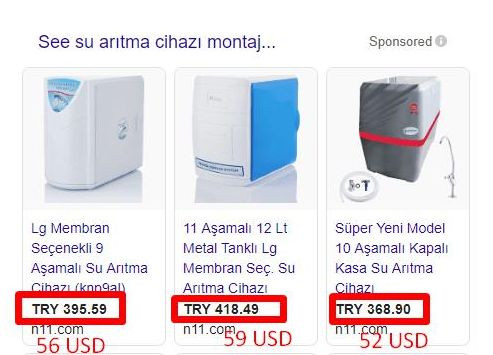
The information in the following image was obtained from the local Turkish Google Shopping website. The price displayed represents the retail price for the end consumer and includes films and pressure barrels (but excludes booster pumps). The retail price indicates that the market price of water purification equipment in Turkey has reached a critical point; however, it can also be observed that the price advantage is lower than that in mainland China.
The Turkish people are hardworking, and most aspire to earn money. This leads the author to conclude that, had there been greater political stability over the past decade, it might have been possible for Turkey to have replaced China in the manufacturing of water purification equipment.
Disadvantages of Russia, Vietnam, Turkey, and Egypt:
1.The clustering effect of peripheral component industries has not yet reached its peak in Russia or Egypt.
2.The technical content of the water purification industry is low.
3.The concept of quality needs to be reinforced.
4.Companies are not willing to invest significant amounts of money in applying for product certification.
5.Product automation is low.
By contrast, emerging countries entered the water purifier industry later, and their learning curve is longer than that of advanced countries. Additionally, the accumulation of experience and the rectification of failures also takes longer than in countries such as Taiwan and South Korea. Another factor is that, due to low wages, there is no urgency within the industry to innovate or to adopt the automatic production model.
It is evident that, for an industry to have the right climate, suppliers need to converge into groups to reduce the frequency of overseas purchases and ensure the timely and immediate procurement of competitive key components locally. In the cases of Russia and Egypt, both countries either need more time to develop industrial clusters or must devise strategies to attract foreign investment and competitors from other countries to establish factories in their respective nations.
Advantages of Taiwan and South Korea:
These two countries entered the water treatment industry earlier and possess the following advantages:
- National quality awareness surpasses that of other emerging countries.
- Product innovation is relatively robust.
- Greater emphasis is placed on product safety and durability.
- There is a deeper understanding of non-toxic products, with companies willing to invest the necessary sums for international product certification.
- Government safety requirements for manufacturers are stringent.
- A responsible attitude is notably strong.
- Manufacturers of various parts and components in the water treatment industry are clustered together. Parts are easily obtainable, large inventories of components are not required, delivery is more flexible, and there is no need to establish one-stop production, which can save manufacturing costs and substantial investments in machinery and equipment.
- Export is duty-free, and the tax rate for imported water purification equipment parts is reasonable, approximately 1-5% (Taiwan).
- There is a willingness to provide a small variety of customised products (Taiwan)
Taiwan’s Disadvantages:
Taiwan faces several disadvantages:
- A shortage of labour.
- Acquiring land is expensive.
- Shorter working hours, more holidays, and higher manufacturing costs.
- A lack of natural resources; all raw materials must be imported.
- Domestic demand is low, leading to a reliance on exports.
Taiwan’s labour costs are several times higher, and manufacturing costs are relatively greater than those in emerging countries. Taiwan is a congenitally poor country, characterised by densely built houses, a lack of natural resources, and a small domestic demand market. Consequently, it focuses on product quality and cost control, as well as on providing a small variety of customised products. Taiwan’s biggest advantage is that it serves as the world’s OEM and ODM factory.
Disadvantages of South Korea:
There are several differences between South Korea and Taiwan. South Korea is more focused on product design and innovation and has a larger population than Taiwan. Additionally, the South Korean domestic market is larger than that of Taiwan. South Korea also places emphasis on the development of its own brands, resulting in a relative lack of willingness to produce items for other brands.
The disadvantages of South Korea are as follows:
- It has the highest wages among the main global manufacturers of water purification equipment.
- It lacks resources for raw materials, such as activated carbon powder.
- The metal fittings used in water purification equipment have not been extensively developed in South Korea’s production technology, meaning they are almost 100% imported from China and Taiwan.
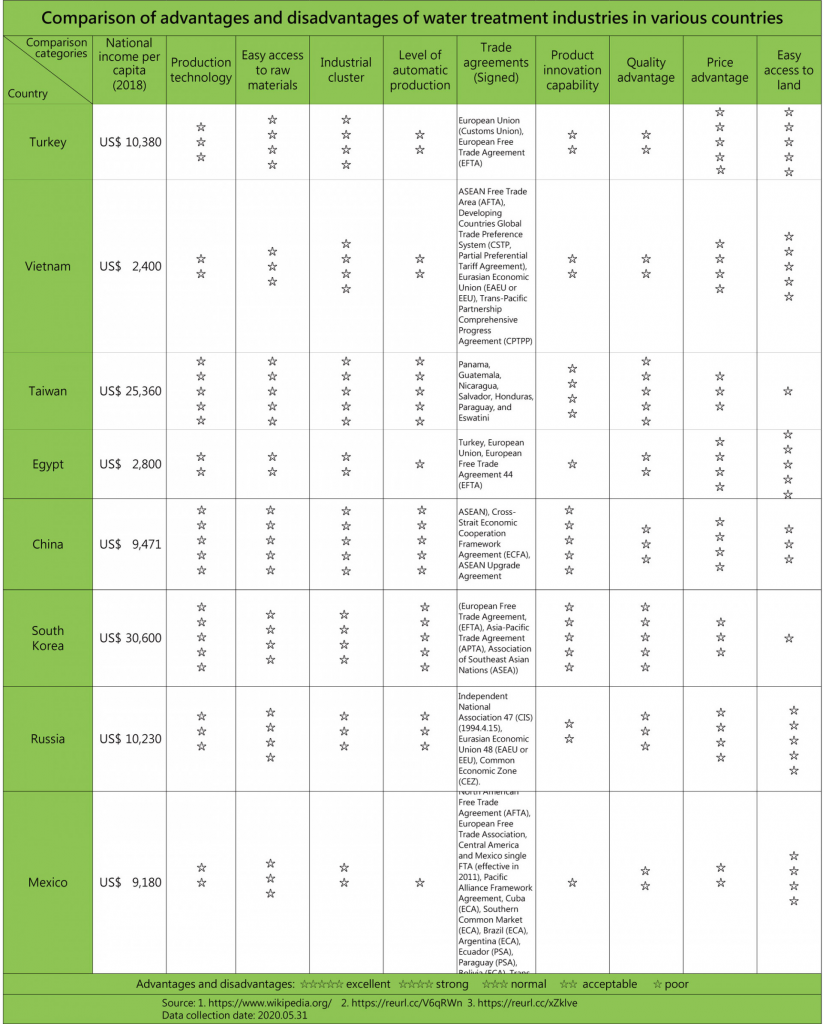
Comparison of the advantages and disadvantages of water treatment industries in various countries
V. Distribution of Global Household Water Purifier Equipment Factories
The author lists ten factories in eight countries around the world, primarily OEM/ODM factories. Ninety per cent of these factories have been visited by the author, ensuring that the credibility and accuracy of this report is objective:
(1)The management and market information within these factories are relatively accurate.
(2) Most of these factories are located in emerging countries (where annual national income is less than $9,000). They possess an advantage in price competition, and global brand factories are also more inclined to purchase from them.
(3) These emerging countries lack the concept of developing their own brands.
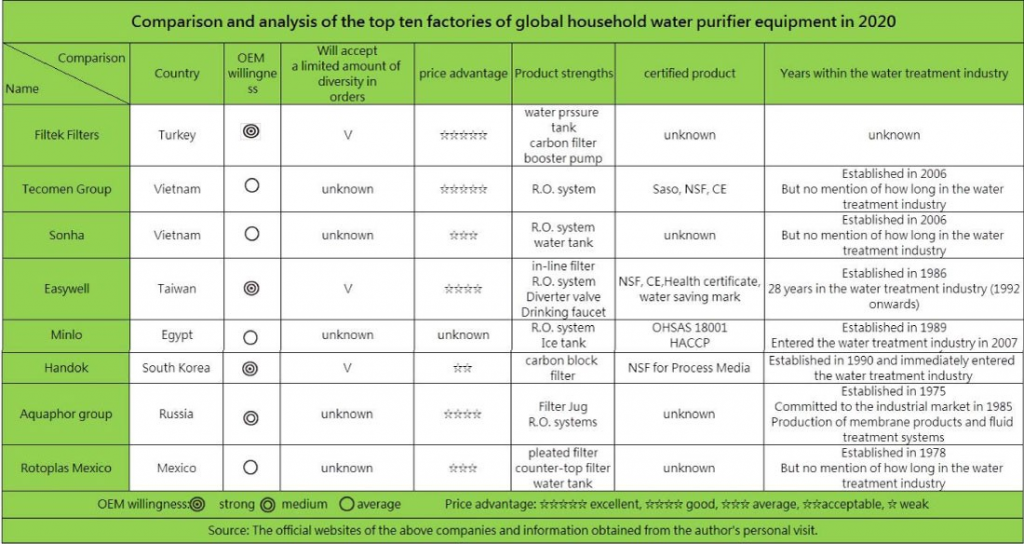
List of the top ten global household water purification equipment factories
We are reporting on and analyzing the following water purifier factories in major countries:
1.Turkey
Filtek Filters
2.Vietnam
2.1 Tecomen Group
2.2 Sonha
www.sonha.com.vn
3.Taiwan
Easywell water Systems, Inc.
4.Egypt
Minlo
5.South Korea
Handok Clean Tech
http://hdctech.co.kr/en/home-en/
6.Russia
Aquaphar
www.aquaphor.com
7.Mexico
Rotoplas
www.rotoplas.com
VII. Internal information and scale of the top ten foundries of global water purification equipment.
1.1 Fil-tek Filters
The author has been fortunate enough to visit the Fil-Tek factory, which spans an area of approximately 8,000 square metres, specialising in OEM production of various parts and accessories for RO pure water machines, and which has also invested in the assembly of pure water machines.
The Turkish company Fil-Tek predominantly operates a one-stop production model, encompassing the manufacture of metal RO pressure drums, pressurisation motors, film processing, and other key components, as well as the production of filter elements and filter bottles. Fil-Tek has been diligently working towards reducing costs. The person in charge stated that there was only one R&D engineer in the entire company, and the author noted that their management expenses were quite low.
1.2 Hazar
1.3 ESLİ Endüstriyel Ürünler Paz.
It is also worth mentioning that the following two Turkish import companies have spent the past ten years transitioning from import businesses to manufacturing plants, investing substantial sums of money to enhance production equipment. Their investments will further restrict the RO reverse osmosis pure water machines and water purifier equipment sector in Turkey.
2. Vietnam
2.1 Tecomen Group
This company previously imported and sold home appliances from South Korea and China in Vietnam. It capitalised on the boom in the Vietnamese water purification equipment market, increasing the import and sales of RO reverse osmosis pure water machines, and transformed the production of water purification equipment. Tecomen has established a large-scale production base in Hanoi, where the number of employees is 2,100 (source: the company’s official website). Additionally, according to the company’s 2019 statement, the combined revenue of its two brands, Karofi and Korihome, already holds the largest market share in Vietnam’s domestic water purification equipment market.
The company began marketing its own two brands from the outset. The Karofi brand caters to the upper-middle-class market, while the Korihome brand serves high-end customers.
In addition to having multiple physical sales channels in Vietnam, Tecomen has also started accepting overseas OEM orders. They participated in and exhibited at the Shanghai Water Treatment Equipment Exhibition in 2019. The company has considerable ambitions and, in recent years, has greatly expanded its physical sales channels in Vietnam, including 3C stores and roadside franchise stores, where everyone can see signage for their products.
Products produced by this company:
- Under-sink RO water systems
- Water dispensers
- Filter housings
- Filter housing
2.2 Son Ha International Corporation
Son Ha was a factory in Vietnam that produced rooftop water storage tanks, which then invested in the RO pure water machine market. When I visited this factory in 2013, I observed that they had temporarily partitioned off an area of about 1,000 square metres inside the factory, which they turned into a simple RO reverse osmosis pure water machine assembly line. Son Ha is a listed company and, like the Tecomen Group, has been developing the domestic market in Vietnam. It has spared no effort and has invested substantial sums of money in developing brands and establishing sales bases to secure the highest market share in the Vietnamese market.
Product items produced by this company:
- Under-sink RO water systems
- Water dispensers
- Water storage tanks
3. Taiwan
Easywell Water Systems, Inc.
This Taiwanese factory is not large; it is small and aesthetically pleasing, yet it ensures that the quality of each batch of goods remains consistent.
Moreover, Easywell distinguishes itself from its peers in water purification equipment through its responsible attitude:
Quality concerns are addressed. Customers are informed, and products in transit and at clients’ sites are recalled. If there are issues with the quality of products from the factory or due to negligent service, the company is liable for any compensation.
Easywell is willing to act as an OEM for larger factories and to undertake a small number of orders with great variety and variability.
Easywell’s OEM products include:
- Filter Jug
- Reverse Osmosis
- Under Sink Purifiers
- Faucet Filter
- Shower Filter
- GAC Filter
- Diverter Valve, Drinking Faucet, Filter Housing
To ensure that the quality of each batch of goods is consistent, the factory’s approach is as follows: Easywell has:
- A number of products (PP filter cartridges, special filters for refrigerators, etc.) that have obtained NSF product certification https://reurl.cc/yy5a8D
- Eight products that were awarded the Provincial Water Label from the Ministry of Economy, Taiwan
- Won the Taiwan Excellence Award for eleven consecutive years
- A total of 54 products that have passed CE safety certification
- Obtained 91 patents worldwide
- Established a test laboratory (in 1986), with expenditures of 17 million yuan over the years on the purchase of testing equipment
- Implemented IQC / IPQC / PQC / FQC / OQC at all times and conducted quality assurance work
- Ensured that the details of daily quality control are unambiguous: the operator independently inspects, continues to inspect, implements gold samples, and conducts first and last parts inspections.
4. Egypt
Minlo
The author visited this company in March 2017. They claim to be the largest water purifier production plant in Egypt, with more than 1,000 employees and approximately 50 injection moulding machines. The factory produces its own:
- Polypropylene melt-blown filters
- Granular activated carbon filters
- Block activated carbon filters
- Various water filter bottles
According to the company’s senior executives, their market share in the Egyptian water purifier market is about 60%. However, there are still many shortcomings in the Egyptian supply chain. They also import key components from Taiwan, such as water storage pressure barrels, PE water pipes, and in-line filters. The main reason this company chooses to purchase from Taiwan is that the goods are both attractive and affordable.
Unfortunately, the author had no opportunity to visit the interior of this factory.
5. South Korea
Handok Clean Tech Co., Ltd.
http://hdctech.co.kr/en/home-en/
This is a Korean factory that specialises in the production of block activated carbon and pre-filter cartridges. The factory is situated in a building of approximately 7-8 floors, although I was only able to visit the production areas on two of those floors. The level of machine automation and labour-saving on site is quite high.
According to the company, South Korea’s major water purification equipment manufacturers have commissioned them to produce filters. They also accept overseas OEM orders.
Product items produced:
- Carbon block filter
- PE sediment filter
- Deodorising filter
6. Russia
Aquaphor Group
The Aquaphor Group is located in St. Petersburg, Russia. The official website claims the company has 3,000 employees. The company’s prices are quite competitive. Aquaphor has a good reputation and a significant market share in many neighbouring countries in Eastern Europe.
Product items produced:
- Filter jug
- Reverse osmosis system
- Under-sink purifier
- Tap filter
7. Mexico
Rotoplas México
Rotoplas is a factory that manufactures plastic water storage tanks for roof taps. Originally, there was a relatively high proportion of them in Mexico City. Rotoplas entered the water purifier market early, around 20 years ago. Initially, it focused on the production of folding, block-shaped activated carbon filters and the necessary plastic filter caps. These are injected, processed, and produced on plastic injection moulding machines imported into Mexico from Taiwan. In recent years, they have gradually developed tabletop water purifiers, although the current pure water machines are still imported from Ningbo, China.
Product items produced:
- Countertop and under-sink purifiers
- Pleated filter
- Water storage tank
VIII. Conclusion
Water purification equipment has evolved from being a star industry over 20 years ago to becoming a super competitive “tragic industry” in recent years. This shift is primarily due to the sudden awakening of many world-famous manufacturers who have recognised the potential of this new industry. They are reinvesting in this sector, whether by establishing their own factories for production, acquiring existing water purifier factories (such as AO Smith, 3M, Unilever), or even by seeking partnerships to produce under a brand while focusing on brand marketing (for example, Whirlpool, Tupperware, Stiebel Eltron, Watts).
It is evident that to survive in today’s water purification industry, companies must not only continually launch new products but also ensure that these products are distinct and possess unique characteristics. Additionally, they must guarantee a high cost-performance ratio.
Reference materials:
Personal interviews conducted by the author.
The official websites of over 10 companies
Taiwan’s 104 Human Bank: www.104.com.tw
Taiwan’s CommonWealth Magazine: https://www.cw.com.tw/
Daily Headlines: https://kknews.cc/finance/65mgpp.amp
Turkey: https://arinaqua.sahibinden.com/
The content of this article is free to use, but please attribute the source